
Construction Site Pest Control: What to Manage at Every Stage
A cleared block is the most attractive thing on the street. Rodents, snakes, mosquitoes and termite risk by construction stage — and the decisions that outlive the project.

Key takeaways
- Ground disturbance displaces rodents, spiders and snakes onto the site and into neighbouring yards.
- Slab and footing stage determines termite risk for the life of the building — sleeve and seal every penetration.
- Once the roof is on, rodents are in the frame cavity and access becomes difficult.
- Landscaping against the slab is the most common bridging detail on a new home.
- The barrier certificate and plan issued at handover are what make the warranty enforceable.
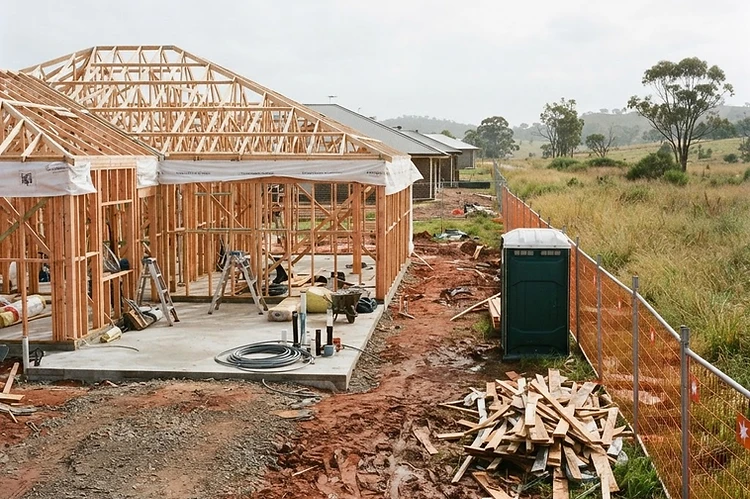
A construction site is a temporary habitat engineered for pests: freshly turned soil, open water, portable amenities, food scraps in bins, timber stacked under a tarp and long grass at the fence line. Add night lighting and constant disturbance of the surrounding ground, and a cleared block becomes the most attractive thing on the street.
Most of what goes wrong is decided early, and most of it can be prevented at very little cost if it is considered at the right stage.
Why a site attracts pests
- Ground disturbance displaces rodents, spiders and snakes from vegetation, spoil and old structures — they relocate rather than disappear.
- Water everywhere in small containers: formwork, wheelbarrows, buckets, sediment fence folds, water tanks, drums, trays and tarps.
- Temporary amenities — site sheds, portable toilets and lunch areas are warm, food-bearing and rarely sealed.
- Food and drink waste at the highest volume any site on the street will ever see from a few dozen people a day.
- Materials as harbourage — timber, plasterboard, insulation, cardboard and plumbing supplies stacked and undisturbed.
- Open structures during frame and roof stage give rodents an easy route in and no reason to leave.
Pest risk by stage
Demolition and clearing. Old sheds, garages and neglected gardens hold rodent populations. Snakes follow the rodents. Brief the client, keep long grass slashed at the boundary, and don't leave spoil piles sitting for weeks.
Slab and footing stage. This is the stage that determines termite risk for the life of the building. Service penetrations for plumbing, conduit and gas must be sleeved and sealed, and no timber offcuts, formwork or packaging may be buried in or under the slab.
Frame and roof stage. Roof trusses, wall frames and wrap are dry harbourage. Once the roof is on, rodents move into the frame cavity and access becomes difficult.
Fit-out and services. Wall cavities and ceiling spaces are still open — the last practical chance to dust and to seal penetrations before linings close.
Landscaping. Garden beds, mulch, planters and sleepers installed hard against the slab are the most common bridging detail on a new home. This is where a good build acquires a long-term termite problem.
Handover. The termite management certificate, barrier plan and inspection schedule should be issued with the keys, not requested later.
Pest risk by construction stage
The decisions that create long-term pest problems are made before handover.
- Item 1.Demolition and clearing
Displaced rodents and snakes move to neighbouring properties — brief the client and the neighbours.
- Item 2.Slab and footing stage
Penetrations for plumbing and conduit must be sleeved and sealed; timber offcuts must not be buried in the slab.
- Item 3.Frame and roof stage
Trusses, wall frames and wrap are dry harbourage; rodents move in as soon as the roof is on.
- Item 4.Fit-out and services
Wall cavities and ceiling spaces are open — the last chance to dust and seal before linings close.
- Item 5.Landscaping
Garden beds, mulch and planters against the slab are the most common bridging detail on new homes.
- Item 6.Handover
Termite management certificate, barrier plan and inspection schedule should be issued with the keys.

Rodents in site sheds and toilets
Site sheds, lunch rooms and portable toilets are the most reliable rodent habitat on any site. What works is unglamorous: a sealed rubbish bin emptied daily, no food left in sheds overnight, porta-loos serviced on schedule, and stations placed along walls rather than in the middle of a room.
If rodents are in the sheds, they are also under the pallets and inside stacked materials.
Snakes and long grass
On cleared land with spoil, timber piles and rank grass, snake encounters rise. Practical management is habitat reduction: slash the boundary, keep materials off the ground and away from the fence line, clear spoil regularly, and never let anyone put a hand into a cavity or under a tarp without checking.
Crews should know the first-aid response and that no one attempts to handle or kill a snake.
Mosquito water on a working site
- Drums and buckets turned upside down or covered
- Formwork and trays stacked to drain, not to pool
- Sediment basins and stormwater pits checked — these are permanent water and need ongoing management, not a one-off
- Water tanks sealed, and taps not left dripping
- Tarps re-tensioned so folds do not hold water
Termites: the cost that outlives the project
The single highest-value conversation on a construction site is about termite management, and it is a documentation conversation as much as a treatment one.
- Barrier product installed to specification, with a certificate at handover
- Penetrations sleeved and sealed, per the plan
- No timber buried, no offcuts in voids, no formwork left under the slab
- Site cut and drainage graded away from the slab so water does not sit against it
- Landscaping specified by someone who understands the barrier — not by whoever installs the garden
Compliance and site safety
Any pest work on a construction site is high-risk work by location, not by complexity. Expect a safe work method statement, site induction, correct PPE, chemical transport and storage that complies with the site's rules, and signage where required. A pest technician turning up unannounced and uninducted is a WHS problem for the principal contractor.
Waste and housekeeping
- Bins with lids, emptied before they overflow, and located away from the building line
- Weekly site clean so packaging and offcuts do not accumulate in corners
- No food waste in general skips
- Cardboard flattened and removed — it is both harbourage and food
What goes wrong, repeatedly
- Pest control engaged at handover, after every preventive opportunity has passed
- Buried timber and unsealed penetrations discovered years later during an inspection
- Garden beds installed against the slab with no regard for the barrier
- Waste management left to whoever is on site that day
- Nobody records what was installed, so the warranty is unenforceable
Working next to occupied neighbours
Most sites in Newcastle and Lake Macquarie are built beside occupied homes, and that changes the obligation. Clearing a block pushes rodents and snakes into neighbouring yards, and the first complaint usually arrives within a fortnight.
What reduces it: slashing and clearing progressively rather than all at once, removing spoil promptly, keeping materials off the ground and away from boundary fences, baiting and monitoring the boundary before demolition, and giving neighbours a contact for reports. A short conversation at the start prevents an awkward one later.
Bulk earthworks and stormwater
Large cuts and fills create new drainage patterns, and stormwater infrastructure is permanent water on a site that previously had none.
- Sediment basins need ongoing mosquito management while they hold water, not a single treatment.
- Stormwater pits and lines should be inspected once installed, before they disappear under paving.
- Water sitting in new pits during the build is the most common source of mosquito complaints from neighbours.
- Any temporary water-holding structure should be emptied or treated on a fortnightly cycle through the warmer months.
What arrives on the pallet
Every material delivered to a site brings cargo that is not on the docket.
Timber is the obvious one: framing, formwork, bearers and ply arrive with borers, termites or fungal decay already present, and stacked timber in a damp corner is a nursery. Pallets are the second: softwood pallets with voids underneath are rodent and spider habitat, and pallets that travel between sites move species across the city. Imported components packed in cardboard or straw are the third, and the only one where inspection on arrival genuinely pays.
The practical rule is the one good builders already follow for a different reason: get materials off the ground, on bearers, with airflow beneath, and do not store them for weeks in the wettest corner of the block. Cover with a tarp that drains rather than a tarp that pools, and rotate the stack rather than adding to it.
Where a container turns up with damaged packaging or visible frass, do not open it inside a structure that people will occupy. Open it on the slab or outside, inspect, and get the packaging straight into the bin rather than into the site's general waste pile.
Night works, lighting and what it attracts
Site lighting is the strongest insect attractant on a residential block, and night works compound it.
Floodlights aimed at a slab draw moths, beetles and everything that eats them, then the geckos and spiders that eat those, and then the birds. Temporary lighting left on all night across a whole street changes the insect population of the area for the duration of the project.
Two small adjustments: aim lights at the work, not at the boundary, and turn them off when the shift ends. Where lighting is needed for security, warmer colour temperature and downward-shielded fittings attract materially less than a bare cool-white floodlight.
Portable toilets and crib rooms deserve a mention here too. A toilet block on a site with no lighting discipline is a stable environment: warm, damp, sheltered, with a light left on. Cockroaches establish in the gap behind the cistern and around the base, which is exactly where a weekly check should look.
The handover package
A project should end with documents, not just a certificate of occupancy.
Ask your provider for: the pre-slab treatment certificate and product used; a plan showing the treated area and the perimeter; a termite management system notice that can stay attached to the building for the next owner; and a plain-language note on what future landscaping or concreting would compromise the barrier.
That last item matters more than it sounds. Most barrier failures we inspect are not product failures. They are a pergola post, a new garden bed or a slab extension added within a metre of the treated zone, some years after handover, by someone who had no idea the barrier was there. The notice is how the next owner finds out before they dig.
Who is responsible on a shared site
On a project with a head contractor and a dozen subcontractors, pest responsibility is usually nobody's until something is found.
Put it in the site induction and the answer becomes obvious. The head contractor owns the site condition — waste, standing water, long grass, the state of the sheds. Each subcontractor owns its own compound and its own offcuts. The pest provider owns the inspection, the documentation and the treatment, and should be reporting to the site manager rather than to whoever answers the phone.
Where a project runs long enough to span a season change, add a review at the transition. A site controlled in winter is a different site in February, when the grass has gone to seed, the water has warmed and the ants are moving.
Winter site, summer site
A project that runs across a season change is effectively two different sites.
In winter the pressure is rodents — cold, wet, and looking for the warmest structure on the block, which is usually the shed with the kettle in it. Trapping and exclusion do the work, and baiting outdoors is close to pointless because there is plenty of natural food and water around.
By February the same block is dry, the grass is seeding, the ants are foraging and the water has warmed. Rodent pressure drops, insect pressure rises, and the termite risk peaks in the wet weeks after a storm rather than in the heat itself.
Program the review at the transition rather than at the end of the project. It is one hour and it stops a program designed for one season being run through another.
Gravel, spoil and stockpiles
Soil stockpiles and gravel beds are structural to a project and, in pest terms, they are habitat.
A spoil heap left against a fence for a season gives rodents cover, gives snakes a basking spot and gives weeds a seed bed. Gravel strips laid for drainage collect leaves and provide a warm, dry microclimate — which is why the ant nests on a new estate appear in the gravel around the slab before they appear anywhere else. Mulch beds laid before handover do the same job, more attractively.
The practical habit is to keep stockpiles away from structures and fences, and to finish gravel edges rather than leaving them open.
How Accurate Pest Control can assist
We work with builders and site managers across Newcastle and the Hunter on stage-based site programs, termite barrier installation and certification, and pre-handover checks.
Frequently asked questions
Written by
Gary Paras
Founder & Senior Pest Management Technician
Gary Paras is the founder of Accurate Pest Control and leads its termite and building inspection work across Newcastle, Lake Macquarie, Port Stephens, Maitland, the Hunter Valley and the Central Coast. Over more than 20 years he has inspected thousands of Hunter homes, from lakeside cottages and coal-town miners' cottages to new-estate slab homes, and specialises in diagnosing termite activity before it reaches structural timber. He writes the practical pest guidance published here, based on what he and his technicians actually find on site rather than generic advice.
- NSW Pest Management Licence 5080776
- Building Consultant Licence BC499
- Fully Insured Public Liability
- 20+ Years Experience — founded 2005
Keep reading


Fleas in the House: Why One Treatment Rarely Ends the Problem
30 October 2026
Read article

Silverfish: Damp, Paper and the Slow Damage in the Dark
30 October 2026
Read article

Bed Bugs: How to Confirm Them, Prepare Properly and Clear Them
30 October 2026
Read article