
Why Ants Come Back After Spraying (and How to Stop the Cycle)
Spraying the trail kills workers and teaches the colony to avoid that surface. Ant control is a finding-the-nest problem, and the bait depends on the species.
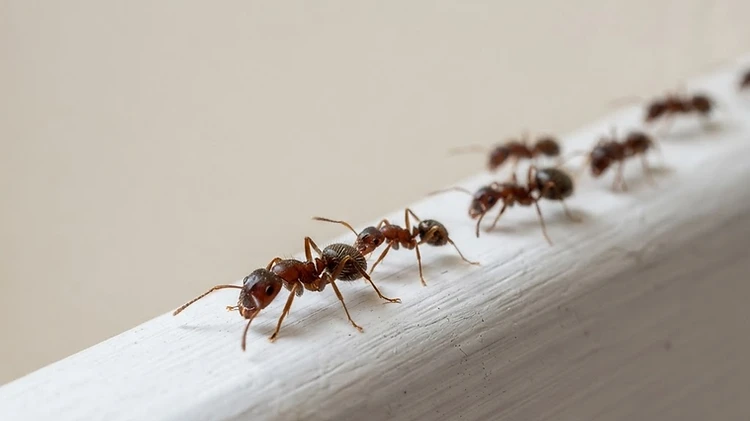
Key takeaways
- A visible ant trail is a foraging column, not the colony — the nest can be twenty metres away under a slab or paver.
- Repellent sprays can cause budding, splitting one colony into several nests that each need treating.
- Match the bait matrix to the species: protein and sugar preferences differ, and the wrong one looks like a failed treatment.
- Leave the trail alone for three to seven days after baiting so workers can carry it back.
- Sealing penetrations and treating the exterior line is what stops the next wave in spring.
Ants are the pest we are called back to most often, and the reason is almost never the product. It is the method. Spraying a visible trail kills the ants you can see and teaches the colony to avoid that surface, which is why the trail reappears three metres to the left a week later.
Ant control is not a spraying problem. It is a finding-the-nest problem.
Why sprayed trails fail
An ant trail is a foraging column, not a colony. The workers you see are a tiny fraction of a nest that may sit under the slab, in a wall cavity, under a paver, inside a retaining wall, or beneath a garden bed twenty metres away.
Repellent spray does three unhelpful things:
- It kills workers, which the colony replaces quickly
- It destroys the pheromone trail, so the colony simply establishes a new route
- It can cause budding — a stressed colony splits into several smaller nests, each of which then needs treating
The result is a yard that looks clean for a week and a house with ants in a different room by the end of the month.
Identify the species — the bait depends on it
Different species prefer different food, and using the wrong bait matrix is the most common reason a baiting program appears to fail.
- Black house ants — small, dark, common indoors, drawn to sweet and protein baits; often nest in wall cavities and under paving.
- Coastal brown ants — sandy-coloured, trail in long lines along edges and weep holes, frequently nest under concrete slabs.
- Argentine ants — light brown, multi-queened supercolonies; they displace other species and can be very hard to eliminate, so management rather than eradication is sometimes the honest goal.
- Bull ants — large, aggressive, solitary foragers with a painful sting; a nest in a garden bed near a doorway is a genuine safety issue.
- Pharaoh ants — tiny, yellow-brown, nest indoors in warm voids; highly prone to budding, so repellent sprays are the worst possible choice.
What effective ant treatment looks like
- Trace the trail back. Where does the column enter the building, and what is on the other side of that wall?
- Inspect the likely nesting zones. Slab edge, garden beds against the wall, pavers, retaining walls, pot plants, roof void and wall cavities.
- Bait rather than spray. Non-repellent bait placed along the trail and near the nest entrance, in a matrix matched to the species — protein for some, sugar for others.
- Leave the trails alone. For three to seven days after baiting, do not wipe the trail or spray it. Workers need to carry the bait back.
- Then seal the entry points. Fill penetrations, replace worn door seals, seal around pipework and repair cracked mortar.
- Treat the exterior line. A non-repellent residual at the perimeter and nesting sites, once the colony has taken the bait.
Timeline: expect activity to increase slightly for a day or two, then drop sharply from about day five. Full control of a large yard population can take two to four weeks.
Why ants come back at all
Even a well-treated property sees new activity, because ants live outside the building and the building has openings.
- Seasonal pressure. In spring and early summer, colonies expand and send out foragers; a warm dry spell pushes them indoors for water.
- Weather. Rain floods nests, and colonies relocate to higher ground — often a wall cavity or a kitchen bench.
- Neighbouring land. A colony under the fence line or a nature strip is outside your boundary but inside your problem.
- New landscaping. Fresh mulch, new sleepers and potted plants all arrive with ants in them.
This is why we treat the conditions and the entry points, not just the trail. A property on an annual program sees far fewer spring invasions than one that calls only when ants appear.
What you can do between visits
- Keep pet bowls and compost away from the wall line
- Do not store firewood, sleepers or mulch against brickwork
- Fix damp patches: ants follow water as readily as food
- Wipe benches but do not spray the trail — call instead, and baits will be more effective while the trail is still active
- Check the dishwasher and kettle area; moisture in a kitchen bench is a standing invitation
Bait myths worth putting to rest
- "Stronger bait works faster." Speed is the enemy. A fast-acting bait kills foragers before they return, so the colony is untouched. Slow is the point.
- "One bait works on every species." Protein, sugar and fat preferences differ, and a colony's preference shifts with the season and the brood. Two matrices are often used in the same visit.
- "Bait stations in the garden are enough." If the colony is inside the wall cavity, the station outside the wall never gets found.
- "Ants carrying white powder means it works." It means they are picking it up, which is a good sign — but only a slow-acting formulation gets carried down the nest.
Watch for the species that need a different response
Fire ants are a reportable pest and are not a do-it-yourself job. If you see a nest mound with aggressive swarming ants, particularly in south-east Queensland and the northern rivers, do not disturb it — contact the NSW Biosecurity Helpline or your council.
Pharaoh ants are small, pale and prone to budding; a repellent spray on a Pharaoh ant infestation can turn one nest into six.
Bull ants nest in open ground and defend it. A nest beside a doorway or in a sandpit is a safety issue and is treated with a nest-specific approach rather than a perimeter spray.
A simple monthly ant routine
Fifteen minutes once a month through spring and summer does more than any single treatment:
- Walk the perimeter and look for new trails along the slab edge and weep holes
- Check door seals and thresholds; replace brush seals when they compress
- Keep the compost, pet bowls and bin area away from the wall line
- Wipe up crumbs, and store sugar and honey in sealed containers
- Note where landscaping has changed — new mulch, new sleepers, new pots
If you see a trail, photograph it before you clean it and call. A trail that is still active is far easier to treat than a gap where ants were last week.
How Accurate Pest Control can assist
We identify the species, find the nest rather than the trail, bait appropriately and then seal the entry points so the treatment holds.
- Ant control — species and behaviour detail
- General pest control
- Pest proofing — closing the openings
- Residential pest control
- Get a free quote
Frequently asked questions
Written by
Gary Paras
Founder & Senior Pest Management Technician
Gary Paras is the founder of Accurate Pest Control and leads its termite and building inspection work across Newcastle, Lake Macquarie, Port Stephens, Maitland, the Hunter Valley and the Central Coast. Over more than 20 years he has inspected thousands of Hunter homes, from lakeside cottages and coal-town miners' cottages to new-estate slab homes, and specialises in diagnosing termite activity before it reaches structural timber. He writes the practical pest guidance published here, based on what he and his technicians actually find on site rather than generic advice.
- NSW Pest Management Licence 5080776
- Building Consultant Licence BC499
- Fully Insured Public Liability
- 20+ Years Experience — founded 2005
Keep reading

New Builds and Renovations: Where Pest Problems Begin
29 October 2026
Read article

Pest Control Newcastle: Straight Answers to the Questions We're Asked Most
29 October 2026
Read article

Pest Control Cost Guide for Newcastle: What Each Job Involves
29 October 2026
Read article