Pest Control Newcastle: Straight Answers to the Questions We're Asked Most
Twenty-five direct answers on cost, timing, safety, termites, cockroaches, ants and rodents in Newcastle — written to be quoted, not skimmed.

Key takeaways
- A general treatment for a standard Newcastle home starts from $330.
- Urgent jobs are usually same or next business day; routine work within two to five days.
- Termite inspections are annual, and are not the same as a general spray.
- Ants return after spraying because the colony is off-site — baiting works better.
- Two visits are standard for fleas, bed bugs and often ants.
If you search for pest control in Newcastle, you will find hundreds of pages that describe services and very few that answer the question you actually asked. This page is the exception: the questions we are asked most often, grouped, with a direct answer first and the detail underneath.
All answers are written for conditions in Newcastle, Lake Macquarie, Maitland, Port Stephens and the Hunter Valley — coastal humidity, clay and sand soils, older housing stock and a long, humid summer.
Booking and pricing
How much does a general pest treatment cost in Newcastle?
A general pest treatment for a standard home starts from $330 and scales with the size of the property and what is included. The price covers interior and exterior treatment, the roof void where accessible, the subfloor, and the usual target pests: cockroaches, spiders, ants and silverfish.
What makes a quote higher?
Four things: size and storeys, the number of pests being treated, whether termites are involved, and travel. Acreage and rural properties also need more product and more time. A quote that does not ask about these is a guess.
Do you charge for a quote?
No. Quotes are free, and we will give you a price range on the phone where the property type is clear. Where it is not — for example a large, unusual or heavily affected property — we will say so and arrange an inspection.
How far do you travel?
Across the Newcastle, Lake Macquarie, Port Stephens, Maitland and Hunter Valley areas, and into the Central Coast. Travel is built into the price by zone rather than added as a surprise, and we will tell you which zone you are in before booking.
How quickly can you come out?
Urgent jobs — wasps, a rodent in a kitchen, a child with a reaction to ants — are usually same or next business day. Routine work is generally within two to five days. Inspections for a property purchase are booked to the settlement timeline.
Do I need to be home?
For an internal treatment, yes, at least at the start. For an external-only service on a rental or a commercial site, no — we can attend with a key or code arrangement, and send the report afterwards.
Treatments and safety
Is the treatment safe for children and pets?
The products used are registered for domestic use and applied at label rate to targeted areas, not broadcast. Keep children and pets off treated surfaces until dry, which is typically a few hours, and follow the re-entry time stated in your report. Aquariums and bird cages need covering or moving, which we will discuss beforehand.
How long does a treatment take?
A standard home takes around 45 to 90 minutes including the walk-through and the report. Larger or heavily affected properties take longer, and a termite treatment is a separate, longer job.
Will I have to leave the house?
For most general treatments, no. For fumigation, yes, and the exclusion period is set by the label. For a heavy German cockroach or flea treatment, leaving for a few hours while it dries is sensible.
Do you spray inside?
Where it is warranted, yes — skirting, cracks and crevices, behind appliances, and the underside of kitchen cabinetry and drawers. Modern interior work is targeted rather than a mist over living areas.
How long does it last?
A residual general treatment typically gives protection for several months outdoors and longer in sheltered internal areas, but the honest answer is that it depends on the pest, the weather and the property. A wet spring, an established ant colony next door, or a compost heap against the fence can shorten it.
Will one treatment solve my problem?
For cockroaches, spiders and silverfish, usually. For ants, often two visits are needed because the colony is off-site. For fleas and bed bugs, two visits are standard. For rodents, the treatment is a program — baiting plus proofing — not a single visit.
Do you use chemicals at all?
We use registered pesticides where they are the right tool, and gel baits, dusts, traps, exclusion work and hygiene recommendations where they are better. Some jobs are solved with proofing and a single bait placement.
Termites
How often should a Newcastle home be inspected for termites?
Annually. In high-pressure areas — older homes with a subfloor, homes near bushland or with timber retaining walls, and homes with a previous history — we recommend a shorter interval or additional monitoring.
Is a termite inspection the same as a pest spray?
No. A termite inspection is a documented inspection against the relevant Australian Standard, using a moisture meter, thermal imaging and a termite detector where needed. It is not a treatment, and a general spray does not prevent termites.
Can termites be treated without tenting the house?
Most termite problems in Newcastle are managed with a chemical soil barrier, an in-ground monitoring and baiting system, or a combination. Full fumigation is unusual and reserved for specific situations.
How much does termite treatment cost?
It depends entirely on the construction and the extent. A soil barrier on a standard home is one job; a baiting program and a partial barrier in a renovated home with concealed access is another. We quote after inspection, not before.
Will a termite treatment add value when I sell?
A current inspection report and a documented management system answer the question every buyer asks. A previous treatment with no paperwork is worth very little.
Specific pests
Why do ants keep coming back after a spray?
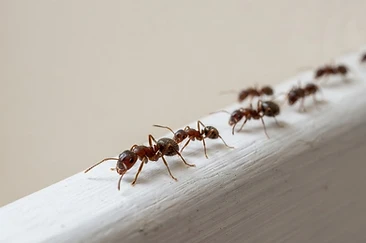
Because the colony is not in the house. Surface sprays kill the workers that cross them and often cause the colony to bud into multiple nests. The effective approach is non-repellent baiting placed where the ants are foraging, plus removing the attractant.
Are German cockroaches different from the big ones?
Yes, entirely. The large ones live outdoors and wander in; German cockroaches live and breed inside — behind fridges, in cabinetry voids, near warm motors — and need gel baiting in harbourages plus hygiene correction rather than a surface spray.
Why do I have rodents in a clean house?
Mice do not need dirt, they need access and food. A gap the width of a pencil is enough. Roof voids, garages, subfloors and the gap behind kitchen cabinetry are the usual routes, and proofing is the durable fix.
Do you bait or spray for cockroaches?
Both, depending on the species. Large outdoor cockroaches are treated with a residual at entry points and harbourages. German cockroaches are baited in the harbourages with gel — spraying them is the least effective option and often spreads them.
How do I know if I have termites?
Look for mud tubes on brickwork and piers, bubbling or rippled paint, sagging floors, tight-fitting doors, hollow-sounding timber, or discarded wings near windows. None of those confirm termites on their own, which is why an inspection rather than a search is the answer.
Should I worry about spiders?
Most Newcastle spiders are harmless. The ones that matter are redbacks in the garden, sheds and letterboxes, and funnel-webs in some areas. A perimeter treatment plus a check of outdoor storage reduces the risk substantially.
Are wasps a problem here?
Paper wasps under eaves and in letterboxes are common in summer, and European wasps nest in the ground and in wall cavities. Nests should be treated at dusk or early morning, when the colony is at rest.
My property backs onto bushland — can I stop pests coming in?
Not entirely, and that is the point: the aim is a treated boundary and physical exclusion rather than eradication. Regular perimeter work plus sealed doors, screens and vents is the realistic strategy.
After the treatment
What should I do after a treatment?
Leave treated surfaces alone until dry, ventilate when you return, do not wash skirting or wipe treated edges for several weeks, and keep pets and children off treated areas. You will get these instructions in writing.
What if activity continues?
Call us. Most warranties include a free re-treatment within the period if the target pest returns, and we would rather see a re-treatment than have you live with the problem.
Do you provide a report?
Every visit, with the products used, areas treated, findings and recommendations. That record is what a warranty claim rests on, and it is what a property manager, insurer or auditor will ask for.
Rentals, strata and commercial
Who pays for pest control in a rental?
It depends on the cause. If the infestation is a result of the tenant's living conditions, the tenant usually pays. If it arises from the property — a failed seal, a pre-existing infestation, structural access — it is generally the landlord's responsibility. Ask the managing agent in writing before booking, and get the decision recorded.
Do I need a treatment to get my bond back?
Only if there is an issue, or if the lease says so. What landlords and agents actually want is evidence the property was left without an active problem. A dated report showing an inspection with no activity is often more useful than a receipt for a spray.
Can you treat a strata unit without the whole building?
Yes for the unit. But if the source is common property — a roof void, a garbage room, a shared wall cavity — treating one unit treats the symptom. We will tell you what needs to go to the owners corporation.
Do you work with property managers?
Regularly. We attend with keys or codes, provide written reports per property, and schedule around tenancy changes. Reports can go to the agency rather than the tenant.
How often should a business be serviced?
Monthly is the baseline for food, hospitality, accommodation and retail. Many offices and warehouses run quarterly or six-monthly with monitoring. The right answer is set by risk and by what the business's own auditor or insurer expects.
Do you provide the documentation for a commercial audit?
Yes — site plan with monitoring points, service reports with findings by zone, trend data, corrective actions and chemical records with safety data sheets.
Before and after the visit
How should I prepare for a treatment?
Clear the areas to be treated: under the kitchen sink, behind the fridge if accessible, and floors in rooms being treated. Keep pets away, cover or move fish tanks and bird cages, and put away food and utensils on treated benches.
What should I do afterwards?
Leave surfaces to dry, ventilate on return, and do not wash treated skirting or wiped edges for several weeks. If you see activity, photograph it and call — a photograph is worth more than a description.
Can you treat in the rain?
External residual work is best done when the surface will stay dry for a few hours. Light rain is manageable; a downpour washes off fresh product. We reschedule rather than waste a visit.
Do you guarantee the work?
Yes, with conditions that we state in writing: a period, a re-treatment if the target pest returns, and the requirement that treated areas are not washed or disturbed. Warranties do not cover new activity arriving after the treatment, which no provider can prevent.
What happens if it rains after a treatment?
External residual work needs a dry surface for a few hours to bond. If heavy rain follows within that window, call us and we will re-attend the external areas at no charge — it is our product that was wasted, not your money.
Do you treat on weekends?
Yes, and evenings for commercial sites where trading hours make daytime impossible. Weekend appointments for residential work are bookable at no premium.
Can I get a report for a landlord or insurer without a treatment?
Yes. An inspection-only attendance with a written report is a standard job, and it is often exactly what a dispute or a claim needs.
How Accurate Pest Control can assist
If your question is not answered here, call and ask — a real pest technician will answer, not a call centre.
Frequently asked questions
Written by
Gary Paras
Founder & Senior Pest Management Technician
Gary Paras is the founder of Accurate Pest Control and leads its termite and building inspection work across Newcastle, Lake Macquarie, Port Stephens, Maitland, the Hunter Valley and the Central Coast. Over more than 20 years he has inspected thousands of Hunter homes, from lakeside cottages and coal-town miners' cottages to new-estate slab homes, and specialises in diagnosing termite activity before it reaches structural timber. He writes the practical pest guidance published here, based on what he and his technicians actually find on site rather than generic advice.
- NSW Pest Management Licence 5080776
- Building Consultant Licence BC499
- Fully Insured Public Liability
- 20+ Years Experience — founded 2005