
Pesticide Legislation in NSW: Licensing, Labels and Records Explained
Who can legally apply pesticides in NSW, what the label actually requires, which records must be kept, and what to check on a quote before you book.
Key takeaways
- Australian pesticide law is three layers: the product is registered, the poison is scheduled, and the user is licensed.
- The label is legally binding — including the rate, the approved use and re-entry advice.
- A commercial application must be recorded; that record is what proves the work was lawful.
- Safety data sheets must be accessible on site for every product stored there.
- Ask for the EPA licence, insurance and a written quote before booking anything.
Most pest control conversations stop at "is it safe?". For a homeowner, a property manager or a business, the more useful question is "who is allowed to do this, with what, and what has to be written down afterwards?" Those questions have answers set by law, and they are the reason a professional treatment differs from a can bought at a hardware store.
This guide explains how pesticide use is regulated in Australia and New South Wales, what a licensed technician must record, and what you should expect to receive. It is general information, current at the time of writing, not legal advice — the requirements do change, and the authoritative sources are the product label, the Australian Pesticides and Veterinary Medicines Authority (APVMA), the Poisons Standard, and the NSW Environment Protection Authority (EPA).
The three layers of regulation
Australian pesticide law is not one rulebook. It is three layers that operate together.
1. The product must be registered. The APVMA registers agricultural and veterinary chemicals for use in Australia, approving the product, the label, the permitted uses and the rates. If a product is not registered, or is being used outside its approved use, it should not be applied.
2. The product must be scheduled. The Poisons Standard classifies medicines and poisons into schedules, which determine who can supply them and under what conditions. This is what controls whether a product is a supermarket item, a restricted veterinary or farm product, or a professional-use-only concentrate.
3. The user must be licensed. In NSW, the application of pesticides for commercial purposes is regulated under the Pesticides Act 1999 and administered by the NSW EPA. A business applying pesticides for payment must hold the appropriate licence, and the technicians doing the work must hold, or be supervised under, the relevant certification.
That three-layer structure explains why a technician cannot simply use "something stronger than the shop sells". The product, the label and the person are all controlled.
Who can legally apply pesticides
The practical split in NSW:
- Householders can buy and use domestic-registered products for their own home and garden, following the label. Aerosols, surface sprays, ant baits and rodent baits sold to the public fall here.
- Commercial applicators must be licensed through the NSW EPA for the class of work they perform, and technicians hold the relevant units of competency. Timber pest inspection work carries its own accreditation on top of the general licence.
- Trainees work under supervision, with the supervisor accountable for the application and the record.
- Farmers and some other landholders have separate arrangements for agricultural chemicals, which is not the same thing as a pest management business operating in a suburb.
If someone offering pest control cannot tell you their licence number and the business cannot show insurance, that is the whole due diligence answer, regardless of the price.
The label is the law
The label is not a suggestion. Once a product is registered, the label directions are legally binding on the user, and following them is what makes an application lawful, effective and defensible.
What the label fixes:
- The approved use — the pests and the situations the product is registered for
- The rate and dilution — applying stronger than the label is not "doing a better job", it is an offence and a safety risk
- The application method and the areas permitted — including whether it may be used indoors, on food surfaces, or near waterways
- Withholding periods — for agricultural situations, the interval before harvest; for domestic situations, the labelled re-entry time
- Safety directions and first aid
An application outside the label is referred to as off-label use and, for commercial applicators, is generally not permitted. This is also why a technician will decline to spray a surface you ask them to treat if the label does not allow it.
Scheduling, and what it means at the shelf
Most domestic pest products sold to the public sit in the lower schedules and carry clear safety directions. Professional concentrates are higher-scheduled: they are not available to the public, they require specific storage and handling, and they are part of why a licensed technician's service costs what it does.
For a business, the practical consequence is simple: you cannot buy the products a professional uses, and you cannot legally have an unlicensed person apply them on your premises.
Records: what must be kept, and why
Record keeping is the part of the law most homeowners never see and most businesses do not ask about. A commercial application must be recorded, and the record is what proves the work happened lawfully.
A service record should include:
- The date and time of application
- The client, the site address and the area treated
- The product name, the APVMA or registration number, and the rate or dilution used
- The quantity applied
- The method of application
- The technician's name and licence details
- Any withholding period, re-entry advice or precautionary statement
- Any mention of treated surfaces, and pest findings
For a business, these records serve three purposes beyond compliance: they show a customer's auditor that a program exists, they support an insurance position if something goes wrong, and they make the next technician's visit informed rather than blind. Records are typically kept for several years, and a business should expect a copy of every visit rather than only a tax invoice.
Safety data sheets and chemical storage
A safety data sheet is not marketing material. It is the reference document that tells anyone on site what the product is, what it does to people, and what to do if something goes wrong. For a workplace, the current sheet for every product on site must be accessible to workers — usually in a folder on site and often also in a digital register.
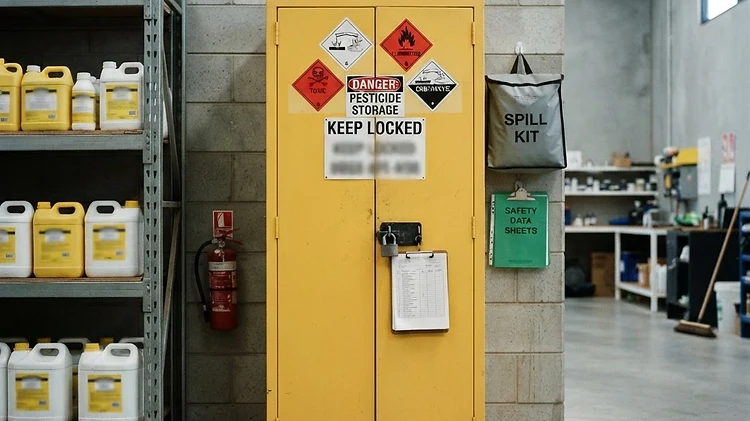
If your business stores any pesticide, even a small amount:
- Keep it locked, in the original labelled container, away from food, stock and ignition sources
- Keep a spill kit and absorbent material with it
- Do not decant into unlabelled bottles — the most common serious error
- Keep the safety data sheets with the store or in a register
- Keep a first aid reference and the Poisons Information Centre number available
Contractor vehicles are effectively a mobile chemical store, and a professional business will be able to show how products are contained, restrained and segregated in transit.
Withholding periods and re-entry
Two different clocks matter after a treatment.
The withholding period applies where a pesticide has been used on a crop or in an agricultural situation, and it is the interval before produce may be harvested, sold or fed to animals. In a domestic or commercial building it rarely applies, but it does come up in food premises, on fruit trees and in horticultural settings.
The re-entry period is the time before people, particularly children and pets, should return to a treated area. For most indoor treatments this is determined by the label and by drying time. A professional will tell you when the area is safe to use and, for a food business, whether any surface needs cleaning before use.
Both should appear on the record, not only in conversation.
Notification, neighbours and sensitive places
Pesticides do not stop at a fence. Two situations call for care and, sometimes, for advance notice.
Strata, shared property and rental situations. Treatment of common property, or of a unit where the treatment may affect adjoining units, should be coordinated with the owners corporation or the managing agent, and notice given to residents. Where a tenant requests a treatment, the landlord's consent and the agent's records matter.
Sensitive places. Schools, childcare centres, aged care, hospitals, and food businesses all carry additional expectations about timing, notice and product choice. Some require treatment outside operating hours, some require a specified notice period to parents or staff, and some restrict which products may be used at all.
A competent provider asks who else is in the building before choosing a product and a time, and a business should confirm its own notification obligations internally rather than assuming the contractor covers them.
Spray drift, off-target damage and complaints
Spray drift is the classic regulatory incident: a product applied on one property that moves onto another, damaging plants, harming bees, or affecting water. It is also the most common trigger for a complaint to the EPA.
Reducing drift is mostly technique and timing: droplet size, pressure, nozzle choice, wind speed and direction, buffer distances, and not spraying flowering plants or during a breeze. For a homeowner, the relevant advice is that a professional will decline to spray in conditions where the product will not stay where it is placed, and that this is a legal consideration rather than caution.
If a person believes a pesticide has been misused, the NSW EPA is the regulator to contact; if someone has been affected medically, call the Poisons Information Centre on 13 11 26 or 000 in an emergency.
Environmental protections that shape the work
Several environmental factors regularly change what can be done on a property:
- Waterways and stormwater: many products must not be applied where runoff can reach a drain, creek or pool, which affects external perimeter treatments and termiticide work.
- Bees and pollinators: applications on or near flowering plants should be timed to avoid foraging periods.
- Native species and wildlife: nesting birds and possums are protected, and treatment must work around them rather than through them.
- Pets, poultry and livestock: treated areas, baits and rodenticide placements must be inaccessible, and secondary poisoning risk has to be considered with any baiting program.
Insurance, licensing and what to check on a quote
A legitimate pest management business will provide, on request and usually without being asked twice:
- Business name, ABN and the NSW EPA licence number for the work being performed
- Current public liability insurance, and professional indemnity
- The technician's certification or accreditation for the specific work, particularly timber pest inspections
- A written quote stating the treatment, the target pest, the number of visits, and what is included
- A service record after each visit
Any of these missing is a reason to pause. Cheapest quote plus no records is not a saving; it is an uninsured risk sitting on your property.
If something goes wrong: incident response
Even a lawful, careful application can produce an incident — a pet that walked onto a wet surface, a person who felt unwell, a neighbour who believes drift affected a plant. Knowing the response in advance is part of being a compliant business.
- Medical first. For any suspected poisoning, call the Poisons Information Centre on 13 11 26, or 000 in an emergency. Have the product name, the registration number and the safety data sheet ready.
- Contain the exposure. Keep people and animals out of the area, ventilate, and do not wash product into a drain.
- Record it. Date, time, what happened, who was present, the product, the amount, the action taken. Memory is not evidence three weeks later.
- Notify where required. A business should follow its own incident procedure, and a provider must follow the notification requirements attached to its licence.
- Review the cause. Was it the label, the technique, the conditions, the client's own actions, or the communication? The answer determines whether it recurs.
Having a one-page incident procedure, with the safety data sheets and the Poisons Information Centre number on it, is one of the cheapest pieces of compliance a business can put in place.
How Accurate Pest Control can assist
We are fully licensed and insured, we record every application in line with NSW requirements, and we provide safety data sheets and written service records with every visit.
Frequently asked questions
Written by
Gary Paras
Founder & Senior Pest Management Technician
Gary Paras is the founder of Accurate Pest Control and leads its termite and building inspection work across Newcastle, Lake Macquarie, Port Stephens, Maitland, the Hunter Valley and the Central Coast. Over more than 20 years he has inspected thousands of Hunter homes, from lakeside cottages and coal-town miners' cottages to new-estate slab homes, and specialises in diagnosing termite activity before it reaches structural timber. He writes the practical pest guidance published here, based on what he and his technicians actually find on site rather than generic advice.
- NSW Pest Management Licence 5080776
- Building Consultant Licence BC499
- Fully Insured Public Liability
- 20+ Years Experience — founded 2005
Keep reading


Food Manufacturing Pest Control: Zones, Monitoring and Audit Evidence
29 October 2026
Read article

Hotel and Motel Pest Control: Housekeeping as the Early Warning System
29 October 2026
Read article

Pest Control Certification in NSW: What to Check Before You Book
29 October 2026
Read article